This semester, I took a FIQWS class on Politics in Literacy. I picked this topic because I was drawn to the connection between politics and literacy and wanted to know how language influences people. At the beginning, I was hesitant to speak in class and make friends but activities like talking to five random classmates helped me step out of my comfort zone and make me feel more connected. The class discussions and random clapping in class will be memories that will be missed. Over the course of the semester, I have developed my skills as a writer and learned how to analyze things very differently.
One of the most significant skills I have developed was analyzing rhetorical strategies in text. Through assignments like the Language and Literacy Narrative and Translation one, I learned to identify ethos, logos and pathos. Then, I understood how the fundamentals of rhetoric convey the deep messages that authors are trying to convey. For example, in Jamilla Lyscott’s “3 Ways to Speak English,” I noticed how she used repetition and tone to express pride in her identity. I wrote in my notes that her use of code-switching was a powerful rhetorical choice that showed how language can convey ideas.
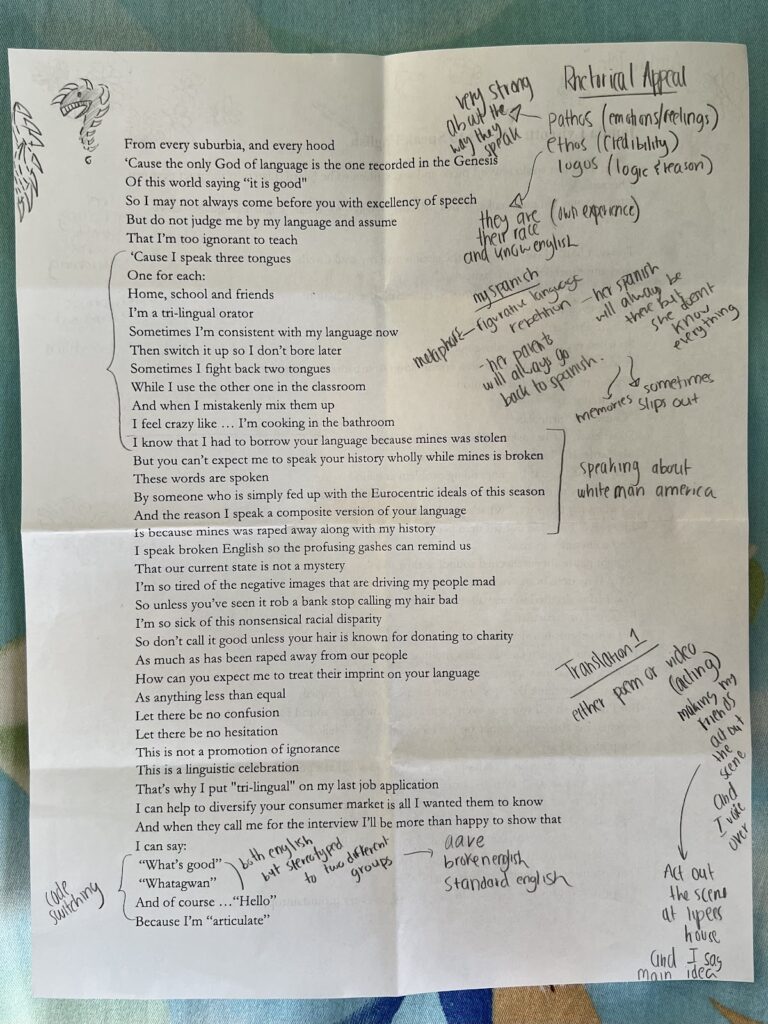
Another way I grew as a writer was learning how to create vivid and emotionally engaging writing. For my first draft of the Language and Literacy Narrative, I received an unexpected grade. This was because “ it didn’t carry significant emotional weight”which showed because “the vivid sensory detail to keep the reader engaged are missing.” I realize that I focused too much on retelling events. I described how I felt in Bangladesh but I could have added how it smelt, sounded or the emotions I felt when I saw my family. The more figurative language and reflection I added to my piece, the more it became interesting. This process showed me how it is important to revise my work and take criticism to improve my narrative. The rhetorical analysis worksheets and group discussions we had in class about our own language literacy narrative ideas also helped me view texts from many different perspectives. It strengthened my ability to interpret and evaluate the intentions behind people’s choice and words.
Research and synthesis skills was another area where I grew significantly. While writing my argumentative essay on biased language in the health system, I was challenged by the lack of evidence. At first, finding sources was difficult and the statistics became very repetitive. However, breaking down the essay into different parts and using tools like the TEES method help me organize my ideas and write clear body paragraphs. During peer review, my partner realized this problem and said “my topic is fried” but since I organized my essay properly, it did not cost me points or made my point invalid. I have learned that having strong evidence-based writing can help solve real world problems, which provides persuasive arguments. This skill will help me in educational writing but also in general with real life issues.
For both assignments, peer review happened and I believe that human interaction is the best form of editing. For translation two, we had to create graphics for our synthesis essay. We had to let someone look at our graphic and guess what our synthesis essay is about. I received feedback suggesting I add more panels to clarify my ideas, which helped me improve my translation but keep my original ideas.
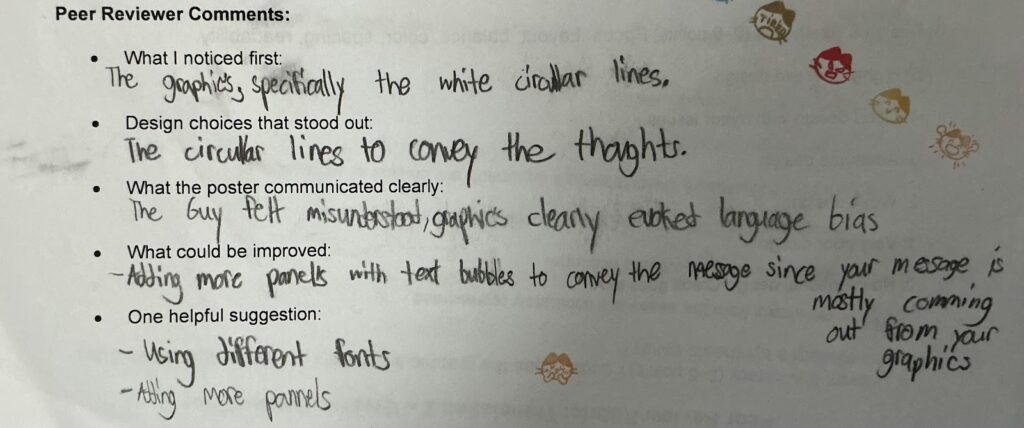
That was a really good insight to hear and I reworked my original piece about five times. I submitted the one I approved of the most and related to the feedback the best. These experiences showed me that constructive criticism from both peers and my instructors are essential to my growth. It encourages me to not be so biased and consider many different perspectives about the same piece. Even the advice my teacher gave me, enhanced my writing and listening to her advice allowed me to get the highest amount of points. In my synthesis essay, for one of my concluding sentences, I forgot to tie it back to the thesis. After my teacher pointed that out, the paragraph sounds better and flows with the whole essay more.
Draft:

Final:

Overall, this semester has taught me many methods that a great writer possesses. I have learned how to take constructive criticism and understand how to write different genres of essays. I would say that these three major assignments were a great introduction on how to write college level essays. I would like to take all of the skills like synthesizing and researching, to the next level of English classes and liberal arts classes in general. Reflection always allows growth and I am glad that I had many chances to grow this semester.

This entry is licensed under a Creative Commons Attribution-NonCommercial-ShareAlike 4.0 International license.

